Appeal by King Mohamed V
On 3 September 1939, Mohamed V, King of Morocco during the French occupation, made an appeal to his people to support France militarily. Hitler-Germany had invaded Poland on 1 September 1939, after which France and the United Kingdom declared war on Germany. Two days later the young Mohamed V (30) joined this declaration. His call was read in all mosques of the country and appeared on 15 September in the Government Gazette. Mr. M. Achahboune gave us a copy of the original text. Translation: Tamer Shahab. Editing: Pim Ligtvoet (May 2020).
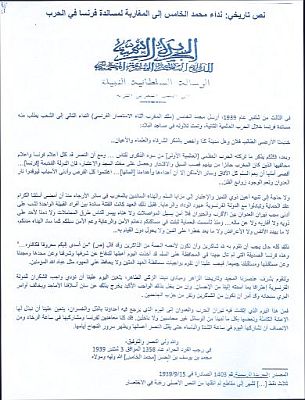
Appeal King Mohamed V (click to enlarge)
The King, or Sultan, his religious title, first speaks about the First World War. He mentions the victory of France and its allies (among which was Morocco), over Germany, the common enemy.
He then praises his predecessors who signed covenants with France, that guaranteed protection, care and support for the Moroccan people. Quarrels between tribes stopped, because France provided safety for roads, transports, transactions, houses and towns, without threatening the people or interfering in religious matters.
The King is concluding this section by quoting the Prophet who said, that the person who is lending you a favour has to be rewarded.
He then states that these days the friendly and peaceful State of France has shown the courage to defend its and also the Moroccan honour, glory and future. Morocco therefore has to be truthful to the covenants and live up to it. Everybody who does not respect this obligation is violating the honour of the ancestors and the commandments of God.
From this day on, with the war raging, the Moroccan people have to give France and its allies full support, until the enemies will draw back. As the Moroccans were covenant partners of France and its allies in times of peace and prosperity, they will be partners in bad times as well, helping it to be victorious.
|
Najiba Abdellaoui
On December 12 2008, Najiba Abdellaoui, who wrote a moving poem about the Moroccon soldiers who fought in World War II, 'I have looked and I have seen' (see below), won the Dutch championship Poetry Slam. The jury praised her for her 'virtuosity in handling language'. The slam contest was held for the seventh year in a row. Slam poets compete before an audience which, often aided by a jury, chooses the best poet. In 2010 Najiba was appointed as city poet of Woerden.
I have looked and I have seen
I have looked and I have seen
Many have looked there, few have seen there
I've crawled on quays
fought by seasoned fragments, undisturbed
I've tasted salty drops and heard the blackest sounds
In a dream I saw the sun shine white
accompanied by the purest orchestra
but it was out of tune,
the dream wasn't mine
but only an abandoned child in a deserted nest
I've seen planes changing into gorges,
rivers into swamps, rotting like broken promises
not yet erased by time
I've seen the moon washing itself in smoke
and shining through a gray mist
I've said good-bye to the stars in the moment of least trust
wishing I could guess their real nature, they kept my gaze in it's bud
With bare hands I carved hope from iron
Weaving a future from loose threads in all colours I've deserved
I've embraced the sea when we first entered it
But soon the desire came
for the whole grains,
the green oil, the volatile sand
I've been a lion, a panther, a cat.
The mysterious warrior from Carthago
staring at the horizon like a blank sheet
But most of all I have experienced
For I have looked and also seen...
And now you come leafing in the past that brings meaning to your present
Make sure it was worth it, the profit, the loss
so this robe won't stick to me in vain
weave my memory in with yours
Before and after 2005, 7, 10...
Don't only look but see
Najiba Abdellaoui, on occasion of the opening of the exposition about Moroccan soldiers in the Second World War, on 24 March 2005.
|
26 North-African and Syrian allies in the Netherlands
20 Bodies of military men washed ashore in Schiermonnikoog, Ameland, Vlieland, Texel, Den Helder, Harlingen, Callantsoog, Castricum, Heemskerk, Velsen, Zandvoort, Wassenaar, Brielle, Scharendijke, Vlissingen (June-September 1940).
One prisoner of war drowned near Willemstad-Gorkum (May 1940), another one died in Amersfoort (October 1943).
3 Wounded military men died in Maastricht (June-September 1940), and one Syrian fell near Assen (April 1945).
|
|
NAME Click on picture to enlarge |
DETAILS
|
Hassan ben ABDALLAH - M
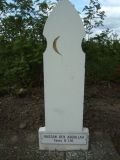 |
Born: 1915 in Zèrral near Marrakech. Military 7th Régiment des Tirailleurs Marocains (RTM), soldier 2nd cl..
Drowned at Dunkirk on 01-06-1940. Body washed ashore on 25-07-1940 on the isle of Vlieland. On 29 July 1949 moved from the Public Cemetery Vlieland to Kapelle (H-3-4). Name not on monument.
Information (2020) about place of birth and military rank: Ogs; year of birth, military unit, date of death and recovery: FranceGenWeb, Droog.
|
Mohamed Ahmed ben ABDEL KADER - M
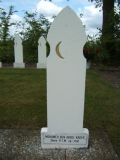 |
Born: 1904 in Morocco, at the time living in Saint Dic (F). Corporal-sergeant 2nd cl. 3rd RTM, nr. 6851.
Body washed ashore on 28-07-1940 on the island of Ameland (Ballum). On 16-08-1949 moved from the Public Cemetery Ameland to Kapelle (H-2-3). Name on monument as Ahmed Ben Abdelkader (8).
Additional information by Jurjen de Boer (Aug. 2006). See J. Kooistra, Strijders, onderdrukkers, bevrijders; Fryslân in de oorlog. 2005
|
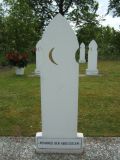
Mohamed ben ABDESSELEM - M?
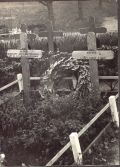 |
Born: 1915 in Algeria, Douar Jaouna. Military RTM. SSRI Maroc P. 2680. Body washed ashore near Wassenaar on 30-07-1940. On 10-08-1949 moved from the cemetery 'Het Lange Duin' to Kapelle (A-1-2). Name on monument as Mohamed Abdesselen (17).
During the same time the body of sergeant Jean Paul Hauttecoeur washed ashore. With horse and cart from shellfisher Kortekaas the bodies were transported to the police station of Wassenaar and buried on 1 August 1940 at the war cemetery 'Het Lange Duin' at the Schouwweg (compare Salch ben Ski, war cemetery Schiermonnikoog). A German cleric said a few prayers and an officer placed a wreath with the French colours. Finally a group of German soldiers fired three salvo's over the open graves Source: Wassenaar in the Second World War, 1995, p. 539). On both graves there was a wooden cross with the inscription 'ici repose' ('here rests') and the name of the army unit. The cemetery existed from 1940 until 1982.
Details Wassenaar: Kees Neisingh (March 2006); Picture: J. Krom (via K.N.). Information date and place of birth: FranceGenWeb, Droog; military unit: Ogs.
|
Messaoud ben AHMED - M
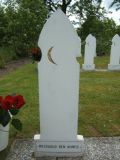 |
Born: Morocco. 1st RTM, sold. 2nd cl..
Body washed ashore on 29-07-1940 at Den Helder. On 7 July 1949 moved from the Military Cemetery Huisduinen to Kapelle (A-1-1). Name not on monument.
Information military unit: Ogs; date of recovery: FranceGenWeb, Droog.
|
Mohamed ben ALI AHMED - M
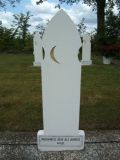 |
Born: ? Sergeant RTM.
Body washed ashore on 29-07-1940 at Heemskerk. Before May 1950 moved from the Protestant Cemetery Heemskerk to Kapelle (H-1-2). Name on monument as Mohamed Ben Ahmed (15).
Information military unit: Osg.
|
Dilmi AINCUR - A
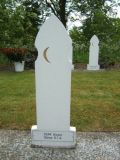 |
Born: 20-06-1907 in Algeria, Algier (Douar Bouhallouan Cme Mixte de Brazza Alger). 13th RTA (Régiment Tirailleurs Algériens), sold. 2nd cl..
Died: 04-06-1940 in Maastricht. On 23 August 1949 moved from the Public Cemetery Maastricht to Kapelle (A-2-2). Name on monument as Dilmi Aimour (5). Probably taken as prisoner of war during the battle at Gembloux.
Information place of birth: FranceGenWeb, Droog; military unit: Droog, Osg.
|
Ahmed ben BELKACEM - M
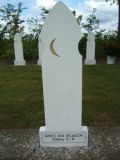 |
Born: 1904 in Morocco, Douar Tabida. 2nd RTM (on monument as 263 RTM).
Body washed ashore on 28-07-1940 on the island of Ameland. Before May 1950 moved from the Roman-Catholic Cemetery Nes to Kapelle (H-2-2). Name on monument as Ahmed Ben Abdelkacem (9).
Information place of birth: FranceGenWeb; year of birth and military unit: Ogs, Droog.
|
Spaki Jam BLAIDE - M/F
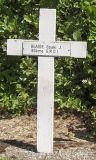 |
Born: ? Moroccan/French. Cavalryman at the 80th GRDI (Groupe de Reconnaissance de Division d'Infanterie), nr. 80 S4 H7, a French-Moroccan reconaissance group. Trained in Rabat et Saintes (F.), especially within the 3rd Reg. Spahis Marocains. Linked to the 1st Div. Infanterie Marocaine and in 1939-1940 to the 237th Div. Legière Infanterie (DLI). This division was active at Gembloux. His body washed ashore on 31-07-1940 in Harlingen (or was taken ashore there). Grave F-38 in Kapelle.
Information: FranceGenWeb, Droog. 'Spaki' is probably 'Spahi'.
|
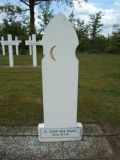
El Achir ben BOUALI - M
 |
Born: ? 7th RTM, sold. 2nd cl..
Drowned on 22-05-1940 during shipwreck. Body washed ashore on 27-07-1940 at Zandvoort. On 9 Sept. 1949 moved from the Public Cemetary Zandvoort to Kapelle (G-1-12). Name not on monument.
Information dates: FranceGenWeb, Droog; military rank: Ogs.
|
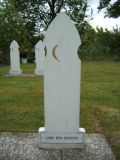
Larbi ben BOUASSA - M?
 |
Born: 1908 in Morocco, Safi, or in Algeria, Douar Aouillet. Military 3d Batt. 7th RI or 7th RTM, sold. 2nd cl..
Body washed ashore on 21-08-1940 at Brielle. Before May 1950 moved from the Public Cemetery Brielle to Kapelle (A-1-3). Name on monument as Larbi Ben Benazza (16).
Information year and place of birth: Ogs, FranceGenWeb, Droog; military unit: Ogs, Droog; military rank: Ogs.
|
Mohamed ben BRAHIM - M
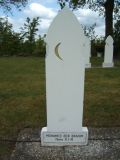 |
Born: 1901 in Morocco. 7th RTM C.3564, sold. 2nd cl..
Body washed ashore on 27-07-1940 at Harlingen. Before May 1950 moved from the Public Cemetery Harlingen to Kapelle (H-1-1). Name on monument (14)
Information recovery: Droog, FranceGenWeb; military rank: Ogs.
|
Abouad ben CHERKI - M
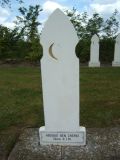 |
Born: 1907 in Morocco, Douar Cherkaoua fon Zarmat. 7th RTM.
Body washed ashore on 28-07-1940 at the isle of Ameland. Before May 1950 moved from the Public Cemetery Hollum to Kapelle (H-2-1). Name on monument as Ahmed Ben Aberki (10).
Information year and place of birth: Ogs, FranceGenWeb, Droog.
|
Mohamed ben DAHAN - M?
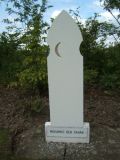 |
Born: ?
His body washed ashore on 02-07-1940 on the isle of Ameland. Before May 1950 moved from the Public Cemetery Hollum to Kapelle (H-3-1). Name on monument as Mahomed Ben Dohan (11).
|
Moktar ben DJILLATI - M
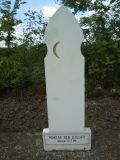 |
Born: ? Sergeant 1st RTM. P63-1935 (6-3-1935?).
Body washed ashore end of July 1940* at the island of Texel (kilometer pole 24). Before May 1950 moved from the Public Cemetery Den Burg to Kapelle (H-3-2). Name on monument with the addition of St (sergeant) (6).
*Other dates of recovery: 20 July (FranceGenWeb, Droog) and 25 July (Ogs).
|
Haddadi HAMOU - A
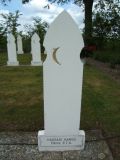 |
Born: 1915 in Donar Drameta, Berrigotville (Constantine, Algeria). Military 11th RTA.
Died as a prisoner of war (P.G.) on 01-10-1943 in Amersfoort as result of illness and was buried at the military part of the Public Cemetery 'Rusthof' in Oud-Leusden. On 5 May 1949 moved to Kapelle (H-1-3): 2nd islamic section, row 1. Name on monument as Hadadi Hamon.
Different place and date of birth at FranceGenWeb and Droog: 7-9-1912 in Dahamchia, Algeria.
|
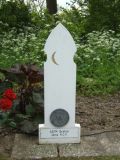
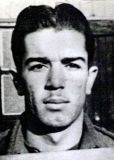
Asem IBRAHIM - S
Picture: tracesofwar.nl
Picture: asseninbeeld.nl (click to enlarge)
|
Born: 07-01-1924 in Damascus, Syria. Soldier 1st class (006721), 3rd Régiment Chasseurs Parachutistes (3/RCP), part of the English Special Air Service (SAS), 1st Squadron, Stick 3.
In September 1942 he joined the Free French Army (FFL) in Somalia, in June 1943 he joined the SAS in England.
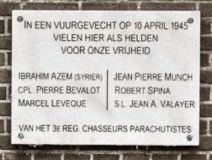
Fallen on 09-04-1945 near Assen, being a part of the operation Amherst. The 33 fallen men of the 2nd and 3rd RCP are commemorated in Assen with a monument for the French Paratroopers (1985) and they received posthumous in 1951 the Dutch Bronze Cross: He distinguished himself by brave and skilful action against the enemy by, after having landed by parachute during the night of 7 to 8 April 1945 behind the enemy lines, partaking in a fearless way in the following combat during which he fell. By this actions contributing to the liberation of the Netherlands and thereby serving the interests of the State of the Netherlands.
A commemorative plate for Asem and 5 fellow-military men is mounted on a barn in Huis ter Heide near Assen. Presumably on 19-07-1949 the remains of the men were moved from the Zuider Public Cemetery Assen to Kapelle (A-3-1). Name on monument as Azem Ibrahim (13). For more information see annex.
|
Ben Allal ben KESSOU - M
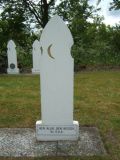 |
Born*: 1920 in Zimour Caid*. Cannoneer 64th Régiment d'Artillerie Afrique (RAA), Haadou 48.1939 [4-8-1939?] T.2 1625.
Died on 18-09-1940 in Maastricht because of an illness attracted during service. Probably taken as prisoner of war at Gembloux (B). On 23 Aug. 1949 moved from the Public Cemetery to Kapelle (A-2-3). This name is on the tombstone. The monument in Kapelle wrongly states: Abdel Kassan (4).
*Different name: Ben Koussou ben Allal (Droog); *Different places of birth: Cercle de Kenisset Annexe de Tedders (FranceGenWeb) and Didesse (Ogs).
|
Ahmed ben KORCHI - M
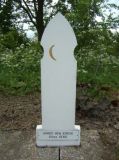 |
Born: ? 'Sapeur' (soldier engineer corps), 31st French-Moroccan Engineer Corps, sold. 2nd cl..
Body washed ashore on 29-07-1940* at Scharendijke (Schouwen-Duiveland). After the war, with many other British victims, moved from the Military Cemetery Haamstede to the British War Cemetery in Bergen op Zoom. From there before May 1950 moved to Kapelle (A-3-3). Name on monument as Ahmed Ben Karchi Ben Ahmed (18).
Information military unit: FranceGenWeb, Droog, Ogs; date of recovery: FranceGenweb, Droog. *Date according to Ogs: 27-9-1940: seems a slip of the pen.
|
Ahmed ben LASKI - M
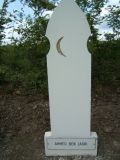 |
Born: ? Morocco. Sold. 2nd cl..
Body washed ashore 23-07-1940 at the Eierlandse Gat on the island of Texel. Before May 1950 moved from the Public Cemetery Den Burg to Kapelle (H-3-3). Name on monument (7).
Information country of birth: FranceGenWeb, Droog; military rank: Ogs.
|
Abdel MALEK - M
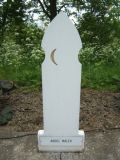 |
Born: ? Morocco. Recruted in 1938 (S853).
Body washed ashore on 12-08-1940 at Vlissingen. Before May 1950 moved from the Noorder Cemetery to Kapelle (A-3-2). Name on monument as Ab del Malek (1).
Information country of birth and military career: FranceGenWeb.
|
Brahamin ben MOHAMED - M?
 |
Born: ?
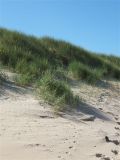
Body washed ashore on 31-07-1940 at Castricum, together with René Verron. Temporarily buried there in the dunes. Verron was buried on 5 november 1940 at the Public Cemetery Castricum. Brahamin was not. His body probably disappeared in sea. Name on monument (3).
Information: this person is missing with Droog.
|
Husein MOHAMED - M
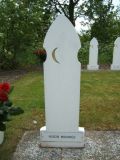 |
Born: ? Morocco. Military RTM, sold. 12837 (12-8-1937?).
Died on 15-06-1940 in Maastricht. Probably made prisoner of war at Gembloux. Before May 1950 moved from the Public Cemetery Maastricht to Kapelle (A-2-1). Name on monument (19).
Information country of birth and military career: FranceGenWeb; military unit: Ogs.
|
Salch Ben SKI - M
Picture: Piet Huisman, municipality of Schiermonnikoog
|
Born: ? STR Maroc.
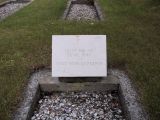
Body washed ashore on 28-08-1940 at the island of Schiermonnikoog and buried at the War Cemetery Vredenhof (see Addendum 4 at Comments on the 26 names). Not in Kapelle. Name on monument in Kapelle as Salch Siki (12).
|
WEDDIDEN - M/F
Picture: eng. Piet Stroo, municipality of Kapelle |
Born: ? Morocco/France. Military 11th Régiment Étranger d'Infanterie (REI). FA 7th Company.
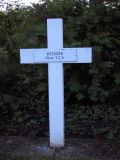
Probably made prisoner of war during combat in the Sedan (F) area and drowned during the transport of around 1200 prisoners of war with the ship Rhenus 127. It was on its way from Walsoorden in Zeeuws-Vlaanderen to Germany. On 30 May 1940 around 19.20 hrs it hit a German magnetic mine at Willemstad. Most of the prisoners saved themselves, some fled and, according to German specification, 167 died. 134 military men were recovered in Willemstad and buried at the Honorary Cemetery near the harbour. Every year a commemoration is held there on the second day of Pentacost. The body of Weddiden washed ashore at Gorkum, where he was buried on 20-06-1940. Before May 1950 moved from the Public Cemetery to Kapelle (C-3-7). Name on monument with the French group as Waddiden.
Information military career: FranceGenWeb, Legionétrangère.fr; Rhenus 127: Facebook Stichting 18 september (30 May 2018).
|
Not identified M
|
Morocco. Body washed ashore on 23-09-1940 at Callantsoog. Grave D-3 2.
Information: FranceGenWeb, Droog.
|
Not identified F/M
|
France/Morocco. Body washed ashore on 30-07-1940 at Velsen. Grave F-3-5.
Information: FranceGenWeb, Droog.
|
- Pictures of graves unless noted otherwise: Pim Ligtvoet
- Sources May 2020: Droog Magazine 2018 (https://www.droog-mag.nl/1940/index.html) [Droog]
- French details cemetery Kapelle (FranceGenWeb); Relevé nr. 46956, webpagina http://www.memorialgenweb.org/memorial3/html/fr/resultcommune.php?act=view&insee=09135&pays=Pays-Bas&dpt=9135&idsource=46956&table=bp&lettre=&fusxx=&debut=0
- Oorlogsgravenstichting (www.ogs.nl) [Ogs]. |
Comments on the 25 North-African and 1 Syrian allied
Mr. J.A. Hey (Hengelo), on personal initiative and, concerning Kapelle in cooperation with the council and Souvenir Français, made an investigation during the years 1970-2000 on military buried in the Netherlands but with a non-Dutch nationality, among them the French military from 1940-1945. On the basis of his research, the information on the graves and supplementary information by author Ad van den Oort, the Oorlogsgravenstichting (Ogs: War Graves Foundation) and Droog Magazine Investigation (4-5-2018), the following analysis can be made (May 2020).
26 miltary with and without grave, with and without monument
- On the list by Hey from 2002 there are 595 names of French military; 24 of them are members of North-African units or Muslims. Droog Magazine Investigation corrected this in 2018 to 26. There are also representatives from other nationalities in Kapelle, like the Polish.
- Many French victims, and 24 of the mainly Moroccan group, have been buried permanently in Kapelle after the war (Zuid-Beveland) on the French Military Cemetery. The bodies of most of the French military though, weren't brought to Kapelle or stayed there after the war, but were returned to France. 229 graves are left, among them about a hundred with the inscription 'non identifié', not identified. Among them are 2 military of Moroccan origin.
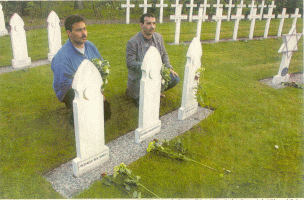
Cemetery Kapelle. Picture: NRC, Evelyne Jacq.
- The Dutch Association 'Souvenir Français' in May 1950 revealed the monument in Kapelle. There are, in gold lettering, 483 then known names of fallen military. Hey's investigation showed that some names are doubled, while other names are missing.
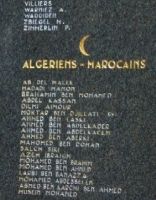
- From the North-African group three names are missing on the monument: the two Moroccan tirailleurs Hassan ben Abdallah, El Achir ben Bouali (both 7th RTM), and Messaoud ben Ahmed (1st RTM). But their graves are in Kapelle. From two others the names are mentioned, but their graves are not in Kapelle. Salch ben Ski is buried at the War Cemetery 'Vredenhof' in Schiermonnikoog, already constructed during the First World War (see Addendum 4 at the end of the Comments). Brahamin ben Mohamed's grave on the beach of Castricum, vanished within the year 1940 into the sea.
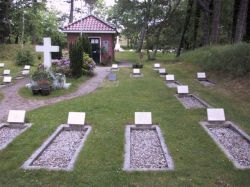
Cemetery Vredenhof, Schiermonnikoog
Picture: Piet Huisman, municipality of Schiermonnikoog
- From the total of 26 North-African and Arabic military who have been buried in Dutch soil, 21 names thus, sometimes with a slightly different spelling, are on the monument. 19 as a group together under a half-moon with epitaphe Algériens - Marocains and 2 military, Blaide and Weddiden in the French group.
Moroccan, French, Algerian, Syrian, non-Muslim
- From the 26 allies, probably 22 are of Moroccan origin: 15 definately, 3 problably; 3 others have a Moroccon/French origine, and 1 a Moroccan-Algerian. There are also 2 Algerians and 1 Syrian.
- From the Moroccan group there are six known addressess, in eight cases the age: between 20 and 40 years. From eighteen we know the military unit. Two were sergeant, one was corporal-sergeant. Fourteen belonged to a Moroccan unit: ten were with the Moroccan Tirailleurs (RTM): the 7th Regiment (5), the 1st (2), the 2nd (1) and the 3rd (1), and one unknown regiment (1); four were with a non specified group. Four others served in an artillery-unit, a reconnaissance-unit, the engineers and in the Foreign Legion.
- Two persons belonged to the Régiment Tirailleurs Algériens (RTA): the 11th and the 13th Regiment. From both an address is known. The Syrian Asem Ibrahim finally, joined in 1942 the Free French Army and became one of the paratroopers who liberated Drente.
- Spaki Jam Blaide and Weddiden have a cross on their graves. Both were Frenchmen with Moroccan roots. According to Sami Kespi of the Maimon Foundation, many of the Moroccan allies were originally (12th to 15th century) from Jewish origin.
- Eli Benazech, buried in the French section D, was earlier mistakenly seen as a North-African on this website. His name is French though, Occitan for 'Benedictus' (Latin). Droog Magazine Investigations corrected this mistake.
Drowned, prisoner of war, wounded/ill, fallen
- The bodies of 20 North-African military have been washed ashore between July and the end of August 1940 on Dutch shore, mostly on the Wadden islands, but also in Zeeland, South- and North-Holland. With them was also the non-identified military who washed ashore on 23 September 1940 at Callantsoog. The date could be a slip of the pen.
- They were military involved in the evacuation of about 200.000 English and 140.000 French troops from Boulogne, Calais and especially Dunkirk to the English Dover. This 'Operation Dynamo', from Dunkirk, officially took place between 26 May and 4 June 1940. The allied troops were surrounded by the Germans and where, in their ships, shelled by the Luftwaffe and sometimes the coast battery. The British navy estimates the number of victims during this evacuation at 8,100 British and 1,300 others. Because of the relatively small number of losses seen from a hopeless military point of view, it soon was called 'the miracle of Dunkirk'.
- From the 848 ships which were part of this evacuation, 72 were sunk by the nazi's. Also 163 mostly smaller vessels were lost in the waves. At least 8 French ships were taken out: German fighter bombers bombarded on the 21st of May near Dunkirk the destroyer 'Adroit', on the 23rd of May near Boulogne the 'Orage' and near Malo-les-Bains the 'Jaguar'. On May 24 destroyer 'Chacal' was hit by a coast battery near Cap d'Alprecht and on May 30 near Nieuwpoort the 'Bourrasque'. On the 31st of May and the 1st of June German planes near Dunkirk sank the 'Sirocco' and the 'Foudroyant'. The freighter 'Douasien' with thousands of passengers on board hit a magnetic mine on 28 May near Dunkirk.
- One military, the French Moroccan Weddiden, washed ashore at Gorkum. He was transported as prisoner of war to Germany by a ship that hit a mine.
- From the 26 five died on land. Three of them in the summer of 1940 in a hospital in Maastricht, where they were taken as wounded prisoners of war from Belgium or North-France. The Algerian Haddadi Hamou was a prisoner of war in Amersfoort and the Syrian paratrooper Ibrahim Asem died in April 1945 at Assen.
- According to a Moroccan witness, sergeant Moughit ben Daoud, who took part with his unit of 34 North-Africans and the 271st Régiment Infanterie in the battle for Zeeuws Kapelle on 16 May 1940, 12 North-Africans lost their lives there. No graves of them are known in the Netherlands. Their names are neither on the monument, nor on the list of Mr. Hey of 84 near Kapelle fallen and buried military.
Addendum 4. Salch ben Ski and Cemetery Vredenhof, Schiermonnikoog
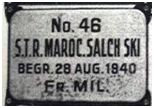
Enamel nameplate with the former number 46.
Source: Vredenhof. Accompanying booklet exhibition Visitor Centre Schiermonnikoog 1998, p. 17
After the war one of the 24 North-African victims, temporarily buried at a Dutch cemetery, was not brought over to grateful Kapelle: Salch ben Ski, or Salch Siki as the monument in Kapelle says. His remains stayed as no. 46 at the cemetery Vredenhof on Schiermonnikoog, where currently are 110 mainly foreign graves. On the 4th of May not only national anthems from The Netherlands, Great Britain, France, Germany, Canada, Australia, New Zealand and Poland can be heard, but also from Morocco.
In this article I will try to clarify why Ben Ski stayed where he was - on Schiermonnikoog. I also will take the view that Salch and Ski are not Moroccan names, and possibly revert to the way names like Saleh (Salah) and Zaki (or Zeki) were pronounced when they were enrolled in the French army (With thanks to Abdel Kwyasse, Amsterdam).
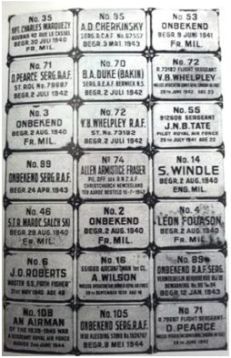
Collection of enamelled nameplates with former number, some double, before 2 August 1949. Source: Vredenhof, p. 17 |
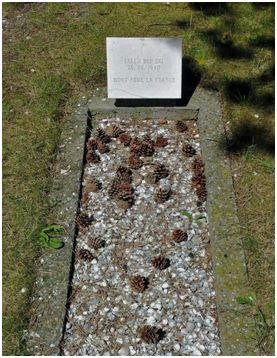
Grave of Salch Ben Ski, 28-08-1940. Mort pour la France. Picture: Pim Ligtvoet 2014. |
31 French military
Salch ben Ski is not the only French military who's grave stayed on Schiermonnikoog. Currently there are 22 men. Seven of them have a name, 15 do not. Their bodies were found on the beach by islanders, layed in coffins and brought to Vredenhof. There they were, save for a few, buried with military honour by the Germans. After 1 June 1941 the beach was a prohibited zone, so only the Germans found the deceased. But soldiers from the French army all arrived before that time. In total between June and December 1940 the bodies of 31 French military washed ashore on this island.
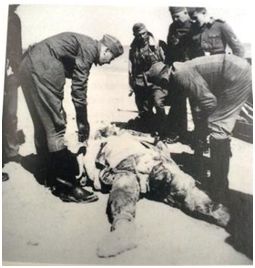
German soldiers find a body. Picture: Bauke Henstra, De oorlog in beeld (The war in pictures). Schiermonnikoog 1940-1945. Louise 2012 ca. p. 139 |
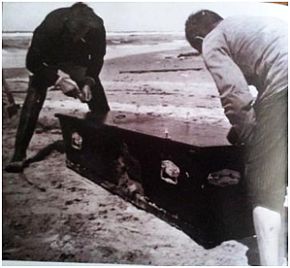
Body layed in a coffin by carpenter Leo van der Veen and grave digger Nico Faber (end July 1940). Picture: Bauke Henstra p. 140 |
Behind the name of the deceased the date was put on which he was buried at Vredenhof. Sometimes also the actual date of death is known which is mentioned separately. With the French-Moroccan ben Ski 28 August 1940 is mentioned as the day of the funeral.
August 1940
This month, especially the first week, is the period during most of the French military are buried at the Vredenhof cemetery for drowned people. In total 22. On 2 August there are 15 men. Among them are Léon Fouason (nameplate no. 4), Guy Bouquet, died on 4 June (plate no. 7), Georges Lepage, Jean Fichant and also some 'inconnus' (unknown). On 3 August it is Antoine Marcel Gaston. On 8 August Gustave Lefranc and an unknown man, on the 17th two unknown French. The body of 'Saleh ben Zeki' is found together with the body of an unknown victim. After that the numbers decrease. In September, October and December every month 1 unknown deceased French military is buried at Vredenhof.
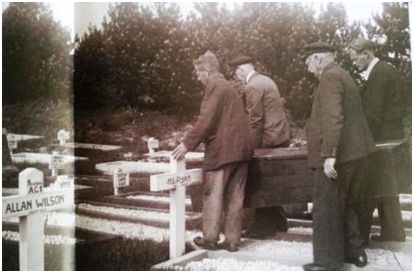
Burial at Vredenhof (1940). Picture: Bauke Henstra p. 151
June and July
What is known about the background and the death of these militairy men? In June and in July 1940 there are three deceased every month from the French army. Pierre Lefebvre (1 June? - seems impossible) and Raymond Feret (4 June) were buried together in one grave. Fernand Lafosse (without date) had a single grave. The first two would have been killed when the mine sweeper Émile Deschamps with 500 French crew hit a mine on 4 June 1940 near Birchington-on-Sea. From Lafosse it is known that he became a victim that day of the nightly collision between the French trailer Maréchal Foch and the British mine sweeper Leda at Dunkirk (Sietze van der Hoek, Vredenhof. Rustplaats voor drenkelingen op Schiermonnikoog (Resting place for drowned persons on Schiermonnikoog). Amsterdam/Antwerp 2003, p. 50. Here the trailer Maréchal Foch is mentioned as Belgian). On 30 July captain Charles Marquezy, former mayor of Roubaix is buried (Schiermonnikoog, Oogappel van Hitler (Schiermonnikoog, Hitlers apple in the eye) a book by writer Wilko Bergmans (1985). https://sites.google.com/site/oogappelvanhitler/home/epiloog-4. He wrongly mentions 28 unearthed French drowned men)(plate no. 35), as well as two unknown, 'inconnus'. It is not known when Salch ben Ski died and under what circumstances. It is known that his body was one of the last French military to be found on the beach of Schiermonnikoog.
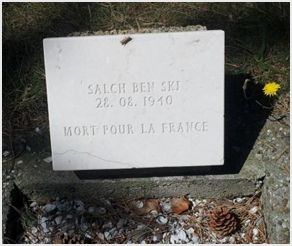
Graf Salch Ben Ski, detail. Picture: Pim Ligtvoet (2014)
Repatriation
From the 31 French buried on Schiermonnikoog, 9 are being repatriated on 2 August 1949 to France. Nine years after the largest French burial at Vredenhof. Who were they?
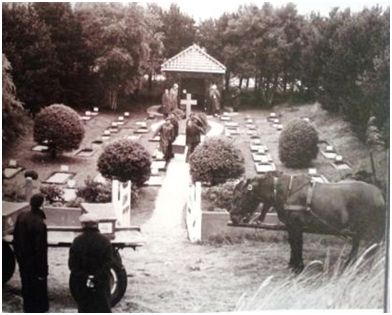
One of the nine unearthed is carried away by French soldiers. Picture: Bauke Henstra p. 145
In any case they were the remains of captain Marquézy, Léon Fouason, Guy Bouque, Gustave Lefranc, and five colleages, who's bodies were washed ashore on or around 2 August 1940. Family members askes for their return. The remains of the other 22 French stayed on the island. Not only were'nt the transported to France, but also not to the new cemetery in Kapelle. Why?
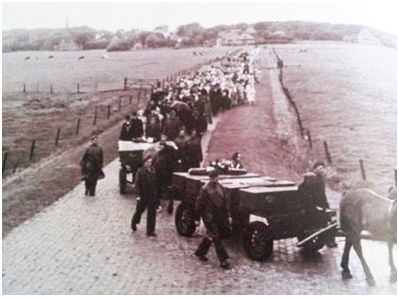
Nine French drowned military from August 1940 are being transported to the harbour (2 August 1949). Picture: Bauke Henstra p. 146
Sake van der Werff
It was mainly Sake van de Werff, former constable and owner of the well-known Van de Werff Hotel, who arranged this. Together with other islanders, with sea-farers and the owner of Schiermonnikoog, Count Georg Ernst von Bernstorff, he had been involved during the last years of the First World War with the construction of the cemetery, and continued doing so. Van der Werff cherished this special cemetery for drowned people. He corresponded with relatives and invited them to come to Schiermonnikoog. After the Second World War he therefore was also in contact with the widow of Marquezy and the French consulate-general. The French authorities agreed to his proposal and left the 22 bodies at Vredenhof. That was not a bad thing for Hotel Van der Werff. Neither for the international diversity at Vredenhof.
International cemetery
Not only is there a mini-French and -Moroccan war cemetery on Schiermonnikoog but also a miniature-German, -Britisch, -Canadian, -New Zealandish, -Australian, -Polish and 'unknown'-cemetery. The graves of the drowned with their nine different nationalities, of two unknown sea-men and one unknown soldier are next to each other or sometimes mixed together. Yet there is a certain structure for the cemetery. As well for nationality as well as for period. When the old terrain became too small, a second field was layed out behind the small grave house. The largest national groups, as seen from the present-day political situation, are the Germans, the French, the British and the Canadians. At the time Salch ben Ski was considered to be a Frenchman, today he would have been Moroccan.
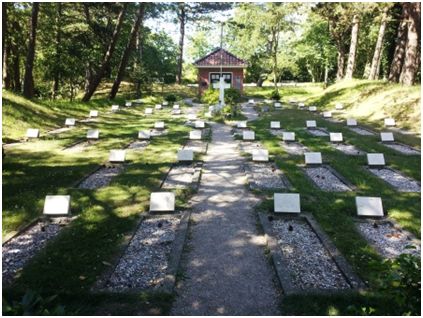
Vredenhof, old cemetery. First row: 9 British (1940-1945). Second (4), third (4) and fourth row (3) up to the cross 11 Germans (1917-1918). The other 27 graves are from French (17, among them Salch ben Ski), Germans (4), British (4) and unknown men (2), from the period 1918-1959. Picture: Pim Ligtvoet (July 2014).
Germany (14)
For a long time Schiermonnikoog was owned by the German Von Bernstorff family. 'Vredenoord' was constructed at the end of the First World War, when the bodies of German military men washed ashore. The core-group of the original cemetery therefore are the drowned men from the German Kriegsmarine from the years 1917 and 1918, eleven men. Together with two German sea-farers from 1921 they lie left and right of the middle path in the three rows in front of the cross of the old part of Vredenhof. In the last row a German sea-farer from 1938 is added; the total now being fourteen. From the time during the Second World War another four Germans were buried, one of them in the old part. To the three at the new part belongs Walter Welzel (10-4-45). For fear of being sent to the battle at Berlin, he committed suicide. Initially the commander refused him a grave at Vredenoord.
United Kingdom (45)
Right at the entrance, before the German graves, left and right of the middle path nine British from the years 1939-1945 are buried. Most of them served with the Royal Air Force (RAF), figurehead Alan Wilson, the first victim of the Second World War to be found at this beach (29-9-1939). Also prominent is John Owen Roberts, captain of the freighter ss Firth Fisher. During the rescue operation 'Dynamo' at Cherbourg, the ship hit a magnetic mine on 21 May 1940. This date is also on his grave. Immediately left after the entrance is the grave of a tenth British man, 'A Seaman, Merchant Navy, Known Unto God' from 1906. Three other British men complete the German rows, one from 1918 and two unknown from the RAF. Apart from these fourteen there are 31 British, most of them from the Royal Air Force, in the new part of the cemetery. The last ones here, two unknown RAF-military men, were buried on 5 July 1945.
France/Morocco (22)
Eight French military are in the graves left and right of the German rows up to the cross, nine are buried next and behind the cross. Together seventeen. The grave of Salch ben Ski is to the right of the cross, place nr. 2. Five other French, two from June 1940 and three from the autumn of 1940, are buried in the first row of the new part of the cemetery.
Unknown (5)
At old-Vredenhof there are also two unknown drowned who were found on the beach between 1940 and 1959. In the new part there are another three unnamed, found between 1942 and 1968.
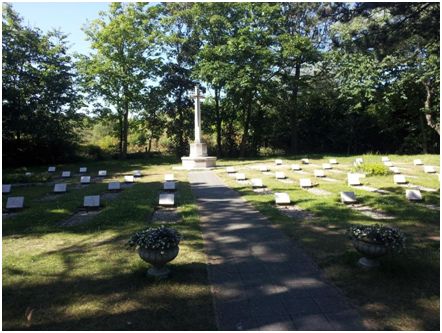
The new part of Vredenhof, with British (31), Canadians (10), French (5), New Zealanders (4), Polish (3), Germans (3) unknown (3), Australian (2) and Dutch (2). Picture: Pim Ligtvoet (July 2014).
British Commonwealth (16)
There are also a large number of buried military men from three former British colonies, Canada (10), New Zealand (4) and Australia (2). They fought in the British army, mostly in their own units. All were buried at the new part behind the old cemetery. Exceptional is the grave of the Canadian flight mechanic Arthur David Cherkinsky who crashed on 2 March 1943. Because he turned out to be Jewish, the German commander refused he was buried with military honour. Arthur was eventually buried (enamel plate no. 95). On his marble grave stone, first one in the fourth row, left of the path, is the star of David.
Poland and The Netherlands
The last two countries represented on the cemetery for the drowned are Poland and The Netherlands. Units from the Free Polish Army were part of the Allied forces. The bodies of three Polish military are in the newer part. Also Sake van der Werff, one of the founders, and his son Tjeerd were buried here.
Conclusion
At the old-Vredenhof 48 men were buried, at the newer part 62. Women are absent. The victims are from nine countries and from unknown. One of them came from Morocco. Unfortunately we do not know who he was, and whether his name is correctly spelled. On his grave there is no cross, no half-moon, no star of David. Perhaps once we find out more about Salch ben Ski or Saleh ben Zaki. He fought for the Allies and drowned. Shells and fir-cones rest on his grave.
The Royal Land Forces had the intention to publish the investigation by Mr. Hey. This intention was never carried out. Also the municipality of Kapelle didn't believe it was their task to publish the data. Mr. Hey then decided to donate all information, photo series and clippings of his investigation to the Zeeuws Archives in Middelburg. The archives then housed part of the information in the archives of Kapelle. The main source of his investigation were the after-war archives from the Dutch Red Cross. This was complemented with Dutch city archives and French reports on repatriated military. After the war graves from French military were found in 120 Dutch cities.
|
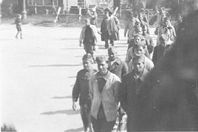
Moroccan soldiers in Flushing (Picture: NIOD / Albert Meerholtz)
|
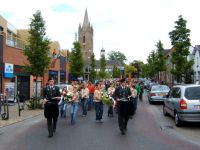
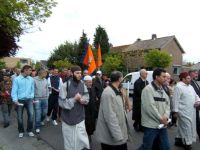
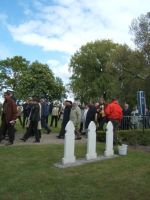
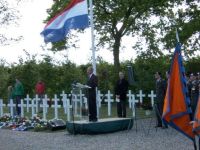
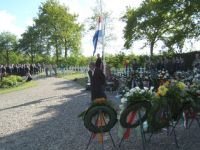
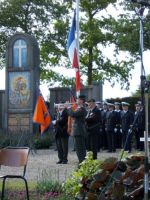
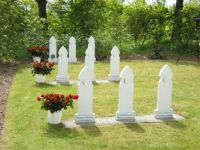
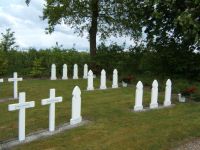
Commemmoration in Kapelle
|
|
 |
 |
 |
 |
 |
 |
 |
 |
 |
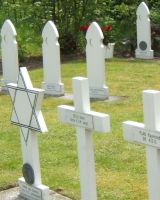 |
Pictures: Pim Ligtvoet, May 17, 2005 |
Moroccan soldiers in Zeeland (Louis Marzouqui)
In the early days of the German attack on Holland, Belgium and France, midst of May 1940, the First Moroccan division (17,000 soldiers) fought between Leuven and Namur at the Dijle-position. 20% - 50% of the Moroccan Tirailleurs regiments (RTM) lost their lives here on 14 and 15 May. During the same period (14-15 May) a mainly North-African cavalry of the 'Spahis' withstood for a day long the German tanks in the French Ardennes near La Horgne; 50 Spahis died.
The Netherlands?
Incorporated in a French infantery corps a possibly Moroccan unit fought on 16 May on Dutch soil, in Kapelle, for the defence of South-Beveland and Walcheren (Zeeland wasn't part of the Dutch capitulation on 14 May 1940). Former sergeant Ben Daoud talked in 2003 about this Moroccan effort with Mohamed Achaboun (Vredeseducatie - Peace Education). According to him, during the battle around Kapelle eight North-Africans were made prisoner of war. It is possible they temporarily stayed in Zeeland. Ben Daoud tells he managed to escape together with thirteen others, without uniform. For three days they received shelter with a Dutchman.
Wounded
After the failure of the French defences in Belgium, about four thousand Moroccan military escaped via Lille to Dunkirk, from where they were evacuated to England or fell at sea (operation Dynamo). Others, who were wounded, stayed in Dutch hospitals; three of them died in Maastricht, one in Zeeuws-Vlaanderen, Schoondijke.
Prisoners of war
Most of the surviving Moroccan military were taken prisoner of war though. They were joined by the troops which returned from England in early June 1940 and fell into the hands of the Germans on the 18th of June. In 1943-1944, some of these Moroccan prisoners of war were forced to work in Holland on the coast defence system. In Zeeland they were housed in Borssele (see Hans Warren, secret Diary, part 1) in fort Ellewoutsdijk and in Koudekerke.
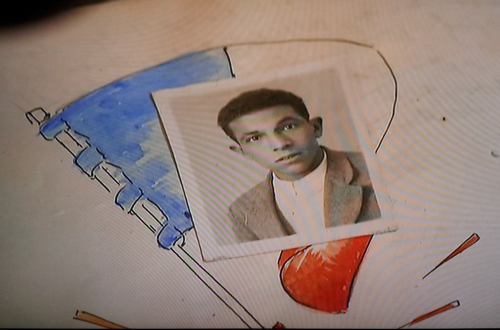
Louis Marzouqui (1944). Source: Tv-program Bureau Marokko,
www.npo.nl/bureau-marokko/23-10-2014/VARA_101369910
Among them was Louis Marzouqui from Rabat. Together with his brother he was stationed in a barak in Koudekerke and worked on the Atlantic Wall in Flushing. On their daily route to an from work they usually stopped near the house were 9 year old Marga van Dijk lived. Some Moroccans made contact with the Van Dijk family and wrote something in the album of verse of little Marga. Marga's older brother Ad made drawing with it. As well as Bellaid Ben Ahmed, who had fallen out with the management of the camp and had to leave, this was Marzouqui. He left a photograph in the back of the album and wrote to her again after the war. From Koudekerke his group had been transported to a camp in Kassel, where they were liberated by American troops.
Extra sources:
- http://fr.wikipedia.org/wiki/Bataille_de_La_Horgne
- Jan Dirk Tuinier en Mohamed Achahboun, Graven in de klei (see literature below), p. 34-41 and 49-51
- http://www.verzetsmuseum.org/museum/nl/tweede-wereldoorlog/themas/marokko/marokko-krijgsgevangen
|
The role of Moroccans in the liberation of Europe
Tuesday 25 May 2004
Theme-night 'Liberation for everyone', Haarlem
Speaker: Chaib Lajlufi
|
Let me start to tell you that I'm not an historian. Originally I'm a pedagogue. In my study and also in my work I've learned how important culture is in forming generations. Culture is something we've inherited from our ancestors. The past makes the future. We can't do without our past. Events from the past can give us a feeling of pride, or a feeling of shame or of guilt.
We shouldn't forget our past; because if we do so, we belie something of ourselves.
Tonight we're going to talk about the liberation at the end of the Second World War, 1945. What I want to talk about specifically is about the role of Moroccans in that liberation. And what this liberation means to the Moroccan Dutch nowadays. I'm not speaking here on behalf of the Moroccans from Haarlem or Holland, I'm speaking here on behalf of myself and from my own perspective.
When preparing this introduction, I've read some literature of people who are engaged in this subject. Especially Achahboun, Obdeijn and Klinkert went into this forgotten part of history.
What it's all about ladies and gentlemen, is that during the Second World War Moroccans joined the fight to liberate Europe. According to Obdeijn, the writer of the book 'History of Morocco', during the first phase of the war 30,000 Moroccans joined the fight. According to Klinkert over 77,000 Moroccans the second phase (period 1942-1945). During the second phase between 1944-1945 over 8,000 Maroccans lost their lives during battles in Europe.
It came as a surprise to me. I didn't know it were that many.
These Moroccans contributed to the freedom of Europe and therefore also to the freedom of Holland.
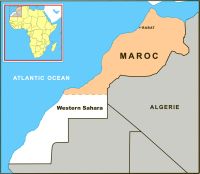
Map: www.unica.org
Morocco then
During the Second World War Morocco was occupied by France and Spain. At that time Morocco was a part of the so-called French protectorate, but this regime very soon developed itself into a colonial regime. France was busy to suppress in a violent way the revolt in Morocco.
I cite from the book of Ad van den Oord 'Todays immigrants & latterday war'(1):
No other choice than to become a soldier.
Said Ou Hamou was a 'Goumier' who took part in the most important allied liberation campaigns in Europe during the Second World War. He told researcher Driss Maghraoui about his motives to serve in the colonial army. As a child he witnessed how his village was 'pacified' by the French. "The mobile infantry came from every side. They bombarded from every side, they bombarded Ait Serghouchen, they had airplanes. People were killed. They took all our cattle and disappeared. Why I joined the Goums? Simply because my father was killed by the French and we were left five orphans. The majority of the adult men of Ait Serghouchen were killed by the French. So a lot orphans were left who had no other choice but to become a Goumier and work for the French."
There were already Moroccans in the French army. When France in 1939 declared war to Germany, after Germany invaded Poland, the Moroccan sultan Mohammed V immediately took for the French side. He didn't hesitate to subordinate the war against the colonial regime to the danger of nazism. Mohammed V ranged himself on the side of the allies.
Through the mosks the sultan made an appeal to every possible sacrifice for France. An enormous wave of applications for the French army followed.
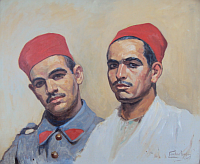
Portrait of two North-African military men in the French army,
by Lambertus Jansen. Paris 1931 (Collection Larense Kunsthandel)
It seems Moroccan soldiers played an important role in May and June 1940 in the defence of South-Holland, Belgium and France.
According to Herman Obdeijn, during the first phase of the Second World War over 30,000 Moroccan soldiers were deployed in the front lines in Northern France and Belgium. During this phase also a small unit of Moroccan and North-African as part of the French infantry came to the aid of Holland in Kapelle, Zeeland, near the defence system at the entrance of the harbour of Antwerp (35 soldiers). They didn't stand a chance, the German troops already were on French soil. A number of them died and others were made prisoner of war. Their graves are unknown.
On the French war cemetery in Kapelle (Zeeland) - where our Prime Minister comes from - 22 other North-African soldiers are buried. Seven of them have been identified as Moroccans. Most of them drowned in May 1940 during the evacuation of French troops to England because of German attacks, and were found later on at Dutch beaches. Some of them died as wounded prisoners of war in Holland and two North-Africans fell during special actions in our country; one of them was an Algerian. They lie there, side by side with christian and jewish victims. One North-African grave is in Schiermonnikoog. Another grave, in Castricum, disappeared.
In June 1940 France capitulated and the regime of Vichy (Philippe Pétain) took over, which collaborated with the Germans. This collaboration also was visible in Morocco because the Vichy regime ruled most of the colonial empire. But sultan Mohammed V refused to hand over his jewish subjects to the Germans. He spoke his veto on excluding Moroccan jews from public functions.
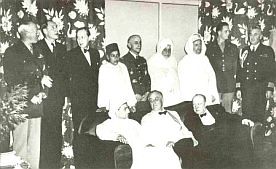
Conference of Casablanca 1943. On the sofa: sultan Mohammed V, president Roosevelt and Winston Churchill. Behind the sultan: son moulay Hassan (Picture: arabworld.nitle.org)
In the summer of 1942 the Americans landed in Morocco and from there the battle against the Germans was carried on at the southern front. During this second phase of the war, from 1942 - 1945, the Moroccan soldiers fought bravely against the Germans. In Italy they formed 30% of the total of allied, next to the Americans, British, Polish and French. They managed to slip through the lines on their mules. In Italy, France and Germany the Moroccans fought fiercely.
-- The following paragraph is not written by Chaib Lajlufi but inserted by the editor. --
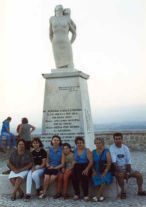
Mamma Ciociara (picture: www.valleluce.com)
It is wry that after the fall of the Gustav Line soldiers of the Goum units and two Moroccan divisions wrecked Italian villages with rape, looting and murder. Their commander, the French general Juin, would have consented to this. This seems strange, because he then ordered summary justice and sentenced 69 Moroccan soldiers, with 15 of them receiving the death penalty. Not only Moroccan soldiers were guilty of these crimes. The rapes were committed later on also in other parts of Italy and in the German cities of Freudenstadt and Stuttgart. Since then the Italian word for mass rape is 'Marocchinate' - literally: Moroccanised women. In Castro dei Volsci is a monument ('Mamma Ciociara') to remember the raped and sometimes murdered women. La Ciociara is the title of Alberto Moravia's novel on this history (1957), and one of the De Sica films with Sophia Loren from 1960 ('Two women').
Sources: Ad van den Oordt and http://en.wikipedia.org/wiki/Marocchinate
-- End of editors paragraph. --
After the war Moroccan soldiers joined a big march-past in Paris as victors of the war.
Sultan Mohammed V of Morocco was honoured by general De Gaulle with the decoration 'Compagnon de la Libération'. The only time this decoration was awarded to a non-French, according to Obdeijn.
These Moroccans fought for the liberty of Europe. They have, with great sacrifice in Belgium and northern France, defended the south of Holland. In May 1940 at the battle in Kapelle, Zeeland, Moroccans died, as also later in war. They have contributed to the freedom of Europe, to our freedom, and we mustn't forget.
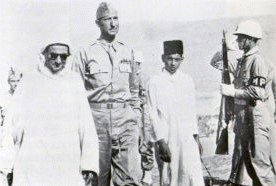
General Clark, sultan Mohammed V and son moulay Hassan (Picture: American embassy Marocco)
Holland now
In Holland we are looking for the cement to bind us together. For sure the liberation can be a part of this, simply because both peoples suffered the consequenses of occupation. And because both peoples joined to liberate us from this occupation.
Up until now the remembrances of 4 May and the feasts of 5 May are dominated by Americans, Canadians and British, and by the remembrance of the jewish Holocaust. Moroccans aren't mentioned.
It is a bit peculiar that the Moroccan community in Holland, neither participates in remembrances, nor participates in the celebration of the liberation. According to my view this can be explained by two reasons. First of all the Moroccan community in Nederland feels alienated from all ceremonies from both the remembrance as the celebration. They don't feel invited and not acknowledged to participate in these national events. They aren't involved in it.
Secondly, most Moroccans in Holland can't understand that especially the jewish community which suffered severely during the occupation, nowadays denies Palestines their freedom. Jews in Israël deport Palestines to other countries. Their lands and houses are confiscated and on a daily basis their houses are demolished and their occupants liquidated without any form of trial. Everything under the motto of security. Apparently someone's security is regarded higher than someone other's. For many Moroccans in Holland this is all hard to digest. Ofcourse not all jews are guilty of todays politics in Israel, but at these events people unfortunately are all seen alike.
As I've said before, during the Second World War Moroccans fought for the freedom side by side with christians, jews and non-believers. After that, the Moroccans helped during the sixties rebuilding Holland. In their work Moroccans still contribute to the prosperity of this country. It can't be denied that there are problems with integration and participation of Moroccans in Holland. The're countless reasons for it. But it's also a fact that in the last years efforts were made to exclude Moroccans. Politicians are putting down Moroccan culture as backward. They demand from Moroccans to change their values for Dutch values. That's not my kind of league.
When we want everyone to fully participate in this society, it's necessary for everyone to feel valued, to involve everyone in a positive way in this society and certainly not by excluding people from it.
To involve the Moroccan community in the events on 4 and 5 May would be a good start.
Thank you.
Chaib Lajlufi
|
Moroccan Jews in Westerbork?
As written elsewhere, sultan Mohamed V refused to hand over his Jewish subjects to the Germans. He spoke his veto on Moroccan Jews being excluded from public functions. Mohamed Achahboun tells Moroccans Jews planted a forest in Hebron in Israël that was named after sultan Mohamed V. During the war at least one Moroccan-Jewish person was in Holland - see below. A family with Turkish-(Osman)-Jewish roots fled to France and from there to Casablanca in early May 1940. The daughter of the house, Simone Valensi, worked there at the Dutch agency (see Turkey, Turkish Jews, List with names II, nr. 20).
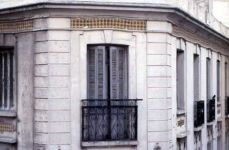
Casablanca (about 1900)
The Jewish-Moroccan woman Luna da Silva Solis-Benchimol, born in Casablanca on 10 December 1910, is listed as 'missing' on the sites of Dutchjewry, the Joods Monument and the War Graves Foundation (until recently as 'Benkimol'). She's the only bearer of the name Benchimol. At the memorial wall of the Hollandsche Schouwburg also the familyname Benchimol is written. Mr. C. Dahan of the Portugese-Israelite Congregation assured us (ed.) though, the family survived (November 2005).
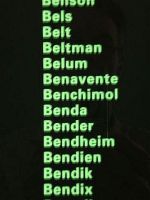
Memorial wall Hollandsche Schouwburg
Luna Benchimol married, according to the municipal archives, in January 1936 in Amsterdam to Désiré Daniel da Silva Solis (Paris, 15 July 1901). On 29 December of that year Maurice was born. The family disappeared on 16 May 1941 to the 'Central Register of Births, Deaths and Marriages'. Usually this meant 'left with unknown destination'. Mr. C. Dahan knows the family fled to the United States, New York. There Désiré Daniel worked for an American bank. In America a daughter was born, Tilly. After the war he became the director of this bank in Tanger, Morocco. Désiré Daniel da Silva Solis sent parcels to Westerbork and Theresienstadt and during and after the war help to the people in Amsterdam. Around 1960 the family returned to Amsterdam. The family lived at the Henr. Bosmanstreet. Mister da Silva Solis was a member of the board of the Portugese-Israelite Congretation and after the war the most active regent of the Portugese-Israelite Seminary Ets Haim. He died at around 1995. Mrs Luna da Silva Solis-Benchimol lives with her daughter in New York. The son is an architect in Holland (information C. Dahan, Amsterdam, November 2005 and Rev. Salomon L. Vaz Dias, New York, January 2007).
From some family members dates of death are known. Marguerite Vieijra-da Silva Solis (38) was killed on 20 March 1943 together with her husband, the chemist David Vieijra (Amsterdam 10 April 1900) in Sobibor (42). Their 5-year old daughter Mathilde Judith was already gassed before in Auschwitz, on 25 January 1943. The family lived in the Van Woustraat 194 in Amsterdam.
In the same street, in the neighbouring house on 196-I lived Marguerite�s and Luna's aunt Mirjam Monnikendam-da Silva Solis (Amsterdam, 13 June 1874); and just like her brother Mozes and her husband Samson Monnikendam they were in the diamond business. Mathilde da Silva Solis-Mannheimer lived-in for a while with her eight children with Mirjam, who became a widow in 1931. Mirjam Monnikendam-da Silva Solis was murdered in Auschwitz on 5 February 1943, 68 years old.
Jacques Joseph da Silva Solis, office clerk, married to the non-Jewish Katherine Ort from Bavaria (1904). The couple had two children, Emil (1933) and Martha Evelyn (1936). None of their names are on the list of victims.
|
Film Indigènes
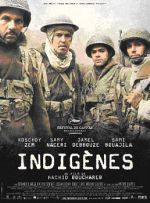
Picture: www.indigenes-lefilm.com
Pension for North-African veterans because of Indigènes?
From mid-January onwards in quite a few movie theaters the film 'Indigènes' is to be seen. It is made by the French-Algerian director Rachid Bouchareb (Cannes 2006). The movie shows the vicissitudes of four North-African soldiers in World War II. One of them (Said) is played by the popular French-Moroccan actor Jamel Debbouze. His grandfather was one of the veterans. Here Jamel plays the assistant of a French sergeant. Debbouze became co-producer as well, and this helped smooth the way for units of the Moroccan Army to serve as extras for battle scenes near the southern Moroccan city of Ouarzazate.
Also in France not many people know that half of the 550.000 French troops that fought the battles of WW II came from the then existing French colonies in Africa: 134.000 Algerians, 73.000 Moroccans, 26.000 Tunesians and 92.000 men form French Equatorial Guinea (the last mentioned, as far as we know, didn't fight in the Netherlands; the estimation of the Maroccan participation on this site are 77.000). The colonial troops mostly were used as canon fodder.
The movie ends in modern times, on a war cemetery in the Vosges. One of the Magrheb veterans visits his fallen comrades. The film text then explains that the pensions of these veterans in 1952, when the French colonial empire started to crumble, stopped. The European Court in 2002 decided that this had been wrong, but the French government refused to pay the surviving militaries. Having seen the movie with his wife, President Jacques Chirac ordered that the payment of the pensions should be started anew. Too late for most of the veterans, but if it happens, it would be an act of justice.
Sources:
Alan Riding, French war movie hits a note of reconciliation (Int. Herald Trib. 27-9-06)
Gerhard Busch, Frankrijks Ereschuld (VPRO-gids 2, 2007)
http://www.volkskrantblog.nl/bericht/77115
|
|


